Queer Places:
Cornell University (Ivy League), 410 Thurston Ave, Ithaca, NY 14850
University of Zurich, Rämistrasse 71, 8006 Zürich, Switzerland
Hull House, 800 S Halsted St, Chicago, IL 60607, United States
Northwestern University, 633 Clark St, Evanston, IL 60208, United States
Henry Street Settlement, 265 Henry St, New York, NY 10002, United States
Laurel Hill East Cemetery, 3822 Ridge Ave, Philadelphia, PA 19132, United States
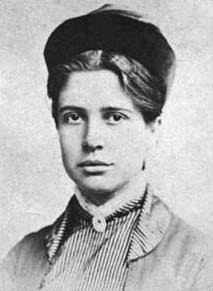 Florence Kelley (September 12, 1859 – February 17, 1932) was born on September 12, 1859, in Philadelphia, Pennsylvania, to a prominent family deeply committed to
abolitionism and social reform through her father, U.S. Congressman William Darrah Kelley. She entered Cornell University in 1876, overcoming obstacles to graduate in 1882,
and later pursued advanced studies at the University of Zurich, where she embraced European socialism and translated works by Friedrich Engels. In 1884, she married
Lazare Wischnewetzky, a Russian medical student with whom she had three children, but she fled an abusive marriage and secured a divorce, subsequently reclaiming her maiden
name and moving to Chicago.
Florence Kelley (September 12, 1859 – February 17, 1932) was born on September 12, 1859, in Philadelphia, Pennsylvania, to a prominent family deeply committed to
abolitionism and social reform through her father, U.S. Congressman William Darrah Kelley. She entered Cornell University in 1876, overcoming obstacles to graduate in 1882,
and later pursued advanced studies at the University of Zurich, where she embraced European socialism and translated works by Friedrich Engels. In 1884, she married
Lazare Wischnewetzky, a Russian medical student with whom she had three children, but she fled an abusive marriage and secured a divorce, subsequently reclaiming her maiden
name and moving to Chicago.
Upon arriving in Chicago in 1891, Kelley joined the reform community at Jane Addams's Hull House, where she famously investigated
local sweatshops, exposing horrific child labor conditions. Her investigative work and advocacy led to her appointment as the first chief factory inspector for the state of
Illinois in 1893. Determined to effectively enforce labor laws, she earned a law degree from Northwestern University in 1894. Relocating to New York City in 1899, she
resided at Lillian Wald's Henry Street Settlement and served as the general secretary of the National Consumers League (NCL) for
decades, championing minimum wage laws, limits on working hours, and the NCL "White Label" to certify fair labor practices.
A tireless intersectional reformer, Kelley helped found the National Association for the Advancement of Colored People (NAACP) in 1909, served as a leader in the National
American Woman Suffrage Association, and acted as a dedicated pacifist during World War I, co-founding the Women's International League for Peace and Freedom. She spent her
later years writing and lecturing on social legislation before passing away on February 17, 1932, in Germantown, Pennsylvania.
References:
Other references:
- Blumberg, Dorothy Rose. Florence Kelley: The Making of a Social Pioneer. New York: Augustus M. Kelley, 1966.
- Sklar, Kathryn Kish. Florence Kelley and the Nation's Work: The Rise of Women's Political Culture, 1830–1900. New Haven: Yale University Press, 1995.
- Payne, Elizabeth Anne. Reform, Labor, and Feminism: Margaret Dreier Robins and the Women's Trade Union League. Urbana: University of Illinois Press, 1988.
- Florence Kelley Papers: Housed at the Rare Books and Manuscripts Division, The New York Public Library, with additional collections at the Schlesinger Library, Radcliffe Institute, Harvard University, and Columbia University.
- National Consumers League Records: Maintained primarily within the Library of Congress Manuscript Division, documenting decades of correspondence with contemporary reformers including Molly Dewson and the Dreier sisters.
- Women's Trade Union League (WTUL) Records: Preserved across various university archives and historical societies, detailing the intersection of labor organizing, legislative lobbying, and networks involving Margaret Dreier Robins and Florence Kelley.
Support this project
This website is a passion project researched, developed, and funded entirely by me. If you find the content valuable and would like to help support the ongoing research and hosting costs, any contribution is deeply appreciated.
Thank you for keeping this independent resource alive!
My books on Amazon: Elisa Rolle's books
BACK TO HOME PAGE
